
BOOK YOUR WORKSHOP TODAY
All posts published here are presented as casual conversation pieces to provoke thought in some direction or another, they do not necessarily represent fixed opinions of the Inner Council, as our work exists beyond the spectrum of bound statement and singular clause.
A poetic guide to soul retrieval and inner child work, exploring how memory, regression, and integration restore the authentic self.
Key Takeaways
- We carry divine essence into life, but early experiences can obscure it.
- Inner child work acts as a form of soul retrieval.
- Revisiting memories reveals lost traits and authentic qualities.
- Soul retrieval requires maturity, respect, and gentle inquiry.
- Regression helps repair fractured memories and release foreign energies.
- Integration restores emotional balance and reconnects us with our true self.
Recovering the Lost Self with the Inner Child
Not in entire forgetfulness,
And not in utter nakedness,
But trailing clouds of glory do we come,
From God, who is our home:
Heaven lies about us in our infancy!
Shades of the prison-house begin to close
Upon the growing Boy,
But he beholds the light, and whence it flows,
He sees it in his joy;
—Wordsworth
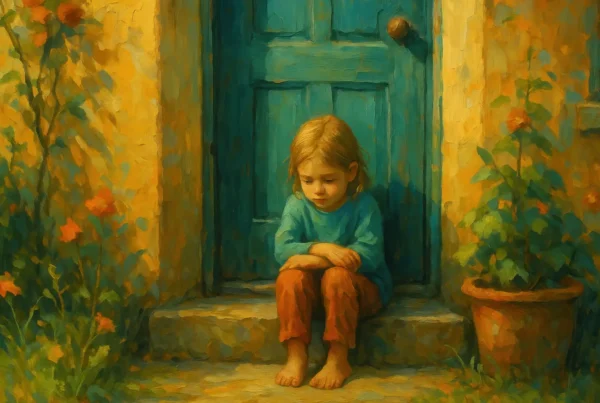
We arrive here from the love of God, carrying the qualities of heaven in the fibres of our being. The divine light enfolds us in the womb and greets us again in the open-hearted embrace of our first caregivers. Yet as childhood unfolds, we wander into a terrain of lower energies, obstacles, and human frailties. Without guidance, a child may lose its way entirely—tangled in the brambles of obstruction, clouded from the radiant thread that once guided its steps. In some cases, the transcendent self cannot fully incarnate, withdrawing so far inward that the child loses conscious awareness of its own presence.
Inner Child work is, in essence, a return to this original light. It is a quiet retrieval of the divine being within us, a reconnection with the familiar characteristics of our true nature.
The Inner Child as Soul Traveller
The journey with the Inner Child is a method of reflective focus. By shining attention onto an old memory, we do more than revisit the past—we invite the past into the present to breathe again. This act of recall serves our ongoing integration. Each return uncovers new clues, insights we were too young or overwhelmed to see the first time. Through this process, we often rediscover aspects of our essence that were left behind: fragments of authentic self that once brought confidence, joy, imagination, or boldness. They approach us like old friends, asking for reunion. We may simply enjoy the nostalgia, or we may reintegrate these traits and bring them home to the present.
I recognise you.
I miss you.
I need you back here with me.
The Hidden Art of Soul Retrieval
Soul retrieval takes many forms, but all share a similar movement: we reach toward a missing piece, an energetic compromise, an abandoned trait. These are the parts we traded away when authenticity seemed too costly. We believed we were maturing, developing, becoming acceptable—to family, to peers, to society. We did not know that a silent inner merchant was soul-trading on our behalf.
Like explorers of antiquity, we anchor ourselves in the present and search for the treasure hidden in old landscapes. We gather clues, memories, impressions—whatever the psyche offers. And when the work is done, we fill those forgotten alcoves with gratitude, bringing peace to the rooms we once fled.
We become time-travelling detectives.
Archetypal diplomats.
Collectors of our own sacred artifacts.
Integration requires maturity and grace. We enter the past as respectful visitors—taking only what we need, leaving no trace of disturbance, and always closing the doors behind us. The suspense of discovery builds slowly, like an unfolding mystery. We play hide-and-seek with ourselves, uncovering the realisations we came here to find.
Regression as a Method of Retrieval
In our workshops, once we have explored re-parenting and emotional triggers, we begin a series of regressions. These sessions start formally but soon adapt to the participant’s unique dynamic. As in ritual and ceremony, the subconscious has thresholds that must be honoured. Respect invites revelation; force invites resistance. At its core, regression is the exploration of an energetic memory offered by the inner child. The intention is to remove the imbalance, trauma imprint, or complex embedded within that memory. When a child receives a jolt of energy from an adult—physical, emotional, or psychological—the soul is confronted with an obstacle it cannot negotiate. Sometimes the adult’s energy has rightful authority, but often an unfair advantage is taken.
Within regression, we use simple but potent tools to restore the child’s spirit. We may confront the intrusive energy directly, counterbalancing its force, or we may mediate the dynamic with compassion and clarity. Sometimes we bring in guides. Sometimes we simply witness. The purpose remains the same: to retrieve a fragment of the authentic self by repairing the fracture of memory and releasing the foreign energies entangled with it. As Freud observed, the repair of memory and the resolution of symptoms occur together—one reveals the other, and they share the same path. The result is a win-win: we gain emotional stability and recover a piece of our child-essence, bringing its voice, vitality, and presence back online.
Living With the Recovered Self
Soul retrieval becomes a way of life for those who feel the call. It is not an occasional practice but a dedication—a gentle tending to the bond with the inner child. Each piece we recover allows us to stand more fully in our wholeness. Our ultimate aim is to embody the inner child’s presence permanently, to let its essence move freely through our adult life. But as the inner child reminds us with quiet wisdom: we must close the doors first. Integration is the final step, the sealing of the past so that the self can live unburdened in the present.
Visit our Inner Child Workshop page to find out more.
Inner Child Exercise: Meeting the Keeper of the Lost Pieces
Purpose:
To retrieve a missing trait, quality, or fragment of essence left behind in childhood, and to reintegrate it safely into the present self.
Ideal for:
Solo practice, guided sessions, workshops, or as a companion to regression work.
1. Preparation
Find a quiet place where you won’t be interrupted.
Sit comfortably, feet grounded.
Take three slow breaths.
On the exhale, gently say (out loud or inwardly):
I am here. I am ready. I am listening.
This signals to the psyche that you are approaching a threshold respectfully.
2. Entering the Imaginal Field
Close your eyes and imagine a soft golden light forming around your body.
This is not fantasy; it is a symbolic doorway into the memory field—what the child remembers and what the soul has held in safekeeping.
As the light grows, allow a sense of movement beneath your feet, as though you are shifting across time without leaving your body.
Say inwardly:
Show me where a piece of me is waiting.
Do not search. Wait to be shown.
3. The Threshold
A scene will begin to form.
It may appear slowly—colours, textures, a room, a landscape, the shape of a moment.
Do not force it. Allow it to reveal itself.
Some people see clearly.
Some feel.
Some simply know.
All forms of perception are valid.
When the scene stabilises, look for your younger self somewhere within it.
It might be the child you expect.
Or it may be a version of you you’ve forgotten.
Approach them gently.
4. Meeting the Keeper
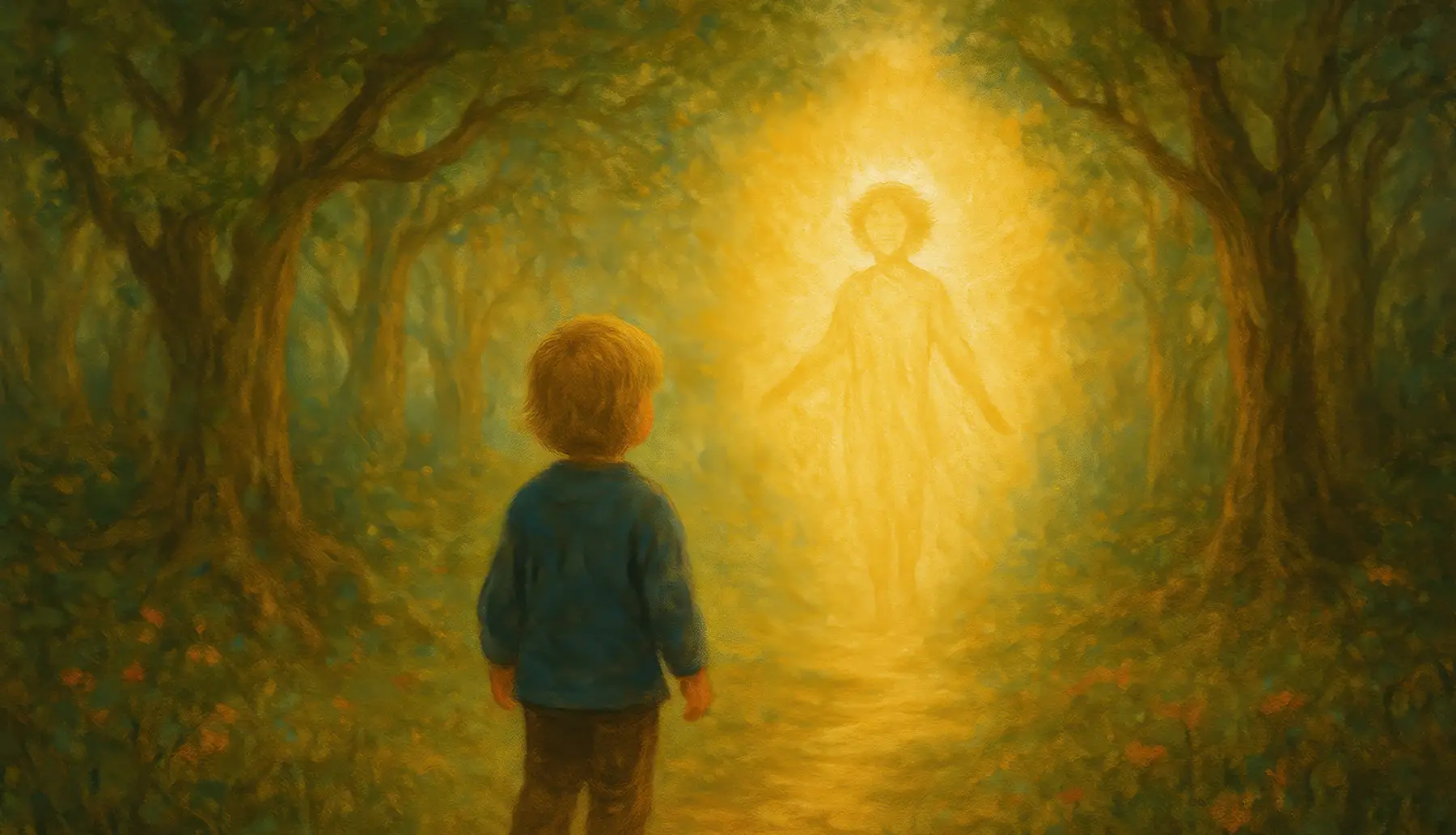
Next to the child, or just behind them, imagine a subtle presence—a guide, protector, or figure of light. This is the Keeper of the Lost Pieces, a symbolic archetype representing what remained intact when the child could not.
The Keeper holds something on your behalf:
- a trait
- a quality
- a soul-thread
- a moment of essence that was put aside for safety
Speak softly to the child:
I’m here. I came back for you. What did you have to leave behind?
Wait for them to respond—through words, gesture, emotion, or an image the Keeper reveals.
5. Retrieval
When the lost piece becomes known—
a spark of confidence, a playful creativity, a bold curiosity, a fierce intuition—
see it as a glowing ember, a small object, a colour, or a symbol.
Hold out your hands.
The Keeper will place it in your palms.
Feel its weight, its warmth, its truth.
Say:
You belong with me. I am ready to carry you now.
Then ask the child gently:
Will you come with me?
If the child hesitates, honour it.
Patience is also healing.
If the child agrees, hold their hand.
6. Integration
Bring the glowing piece to your heart.
Breathe it inward until it melts into your chest.
Feel it spreading through your body—
subtle, powerful, familiar.
Say:
I welcome this part of me home.
Allow a few breaths for the integration to settle.
Feel your adult self expanding to make space for its return.
7. Closing the Doors
Imagine the scene around you dissolving back into light.
The child steps forward and merges with your body, resting safely within you.
Whisper:
Thank you for waiting for me.
The Keeper bows and fades.
Take one final breath and see the doors of the memory gently closing—not locked, not sealed, simply complete.
When ready, open your eyes.
8. Reflection Questions
After the exercise, you may wish to journal:
- What quality or trait did I retrieve?
- How did the child appear today?
- What emotion surfaced?
- How does this piece want to express itself now?
- What change do I sense in my body or mood?