BOOK YOUR WORKSHOP TODAY
All posts published here are presented as casual conversation pieces to provoke thought in some direction or another, they do not necessarily represent fixed opinions of the Inner Council, as our work exists beyond the spectrum of bound statement and singular clause.
A mythopoetic guide to healing parental wounds by meeting the Mother Wound, Father Wound, and returning to the Inner Child for deep lineage repair.
Key Takeaways
- Parental wounds arise from intergenerational patterns—not personal failings.
- The Mother Wound shapes belonging and emotional safety; the Father Wound shapes structure and inner authority.
- Seeing the Inner Child within each parent softens blame and opens the path to integration.
- Inner Child work restores what was missing from parental bonds and begins true lineage healing.
The Threshold We All Eventually Reach
Every human life moves toward a moment when the past begins to speak with a different clarity. This moment arrives as invitation rather than recollection, felt as a quiet pressure in the chest or a growing awareness that certain patterns carry a weight older than personal history. Something within the lineage seeks recognition, feeling, and coherence, and its call arises through sensation, repetition, and emotional gravity rather than through thought or analysis.
This threshold unfolds through many pathways. For some it comes gently, through reflection and gradual insight. For others it emerges through rupture, loss, or decisive change. In every case, attention turns toward the first relationships that shaped us, approached through their living influence rather than remembered events. What once felt personal begins to reveal itself as part of a wider continuity, a stream of temperament, expectation, and emotional reflex moving through generations.
From this wider view, healing the mother wound and the father wound becomes an act of lineage awareness rather than accusation. The work attends to patterns rather than personalities, to transmission rather than fault. Childhood reveals itself as a field where grief, strength, silence, and longing passed quietly from one generation to the next, shaping nervous systems and inner worlds long before language or choice emerged.
People arrive at this threshold for many reasons. Some carry memories shaped by visible pain or conflict. Others recall stability and care while sensing an emotional undertow older than their own story. Many discover that what lives within them bears the imprint of sacrifices, adaptations, and ruptures that existed before their arrival. Here, a clear understanding settles in. Inner healing unfolds through the inner world itself, with privacy, care, and dignity. The psyche holds pathways for restoration, and as these pathways open, change moves outward, touching relationships, family narratives, and ancestral threads.
This work brings life into greater presence. It restores agency in the now. It gathers scattered aspects of identity and returns them with clarity and strength. From this ground, the deeper architecture of inheritance comes into view, and the journey forward begins with a steadier orientation toward what has been carried and what now seeks integration.
The Lineage We Inherit
Long before language forms or memory consolidates, each person enters an emotional climate already in motion. Lineage lives as atmosphere as much as history, carried through tone, posture, silence, expectation, and nervous system rhythm. It moves through families as a living field of unfinished stories, unspoken loyalties, and inherited ways of responding to the world. Names and dates mark the surface of this inheritance, while beneath them flow patterns of love, fear, resilience, and grief shaped across generations.
Some inheritances announce themselves clearly. A parent’s voice echoes in one’s own. A familiar softness, urgency, or ambition repeats itself. Other inheritances operate quietly, shaping how safety is felt, how conflict registers in the body, how closeness is approached, and how worth is measured. Anxiety may gather in the chest without an obvious cause. Silence may carry more meaning than speech. Love may feel tied to performance, usefulness, or restraint. These patterns often originate far upstream, formed in lives shaped by circumstances that allowed little space for reflection, repair, or emotional completion.
Within this wider view, each person appears as a steward of what has been carried forward. Lineage expresses itself through those with the sensitivity to feel its currents and the capacity to sense where coherence seeks restoration. Empathic and perceptive individuals often find themselves holding emotional material that others in the family system learned to suppress or bypass. This sensitivity functions as an instrument rather than a burden, allowing the field itself to begin shifting through awareness, presence, and care.
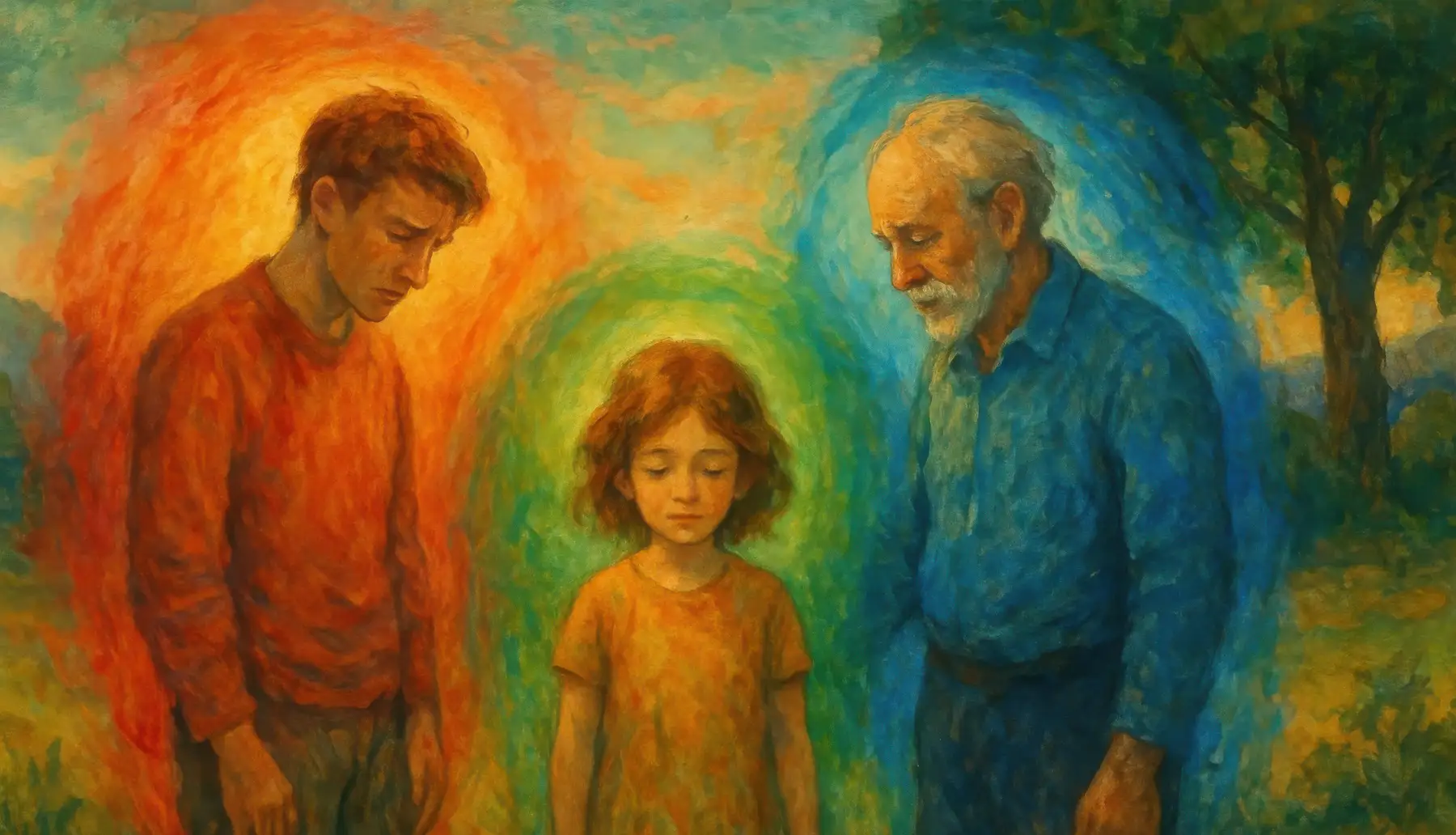
Parents stand within this lineage as carriers of their own unfinished stories. Behind each mother and father stretches a long line of others who adapted, endured, and survived in ways shaped by their time and circumstances. When this perspective takes hold, family history opens into a wider landscape of human experience. Parents appear less as isolated figures and more as expressions of forces that shaped them long before they shaped anyone else. Their Inner Children remain present within them, shaped by what they received and what remained absent.
From this vantage point, compassion arises naturally, grounded in understanding rather than sentiment. The architecture of inheritance becomes visible. Wounds reveal their origins. Strengths reveal their sources. Standing at this intersection between what has been and what seeks to emerge, attention turns toward the two primary relational imprints that orient early life: the Mother Wound and the Father Wound, each carrying a distinct pattern of transmission and each offering its own gateway into integration and repair.
Seeing the Inner Children of Our Parents
As work with parental wounding deepens, a pivotal recognition emerges. Each parent carries an Inner Child. Beneath the roles of authority, responsibility, and adulthood lives a younger self shaped by longing, adaptation, and unmet need. This younger self continues to influence behavior, emotional range, and relational capacity, often quietly directing choices made later in life.
Most parents raise children from within the limits of their own unintegrated childhood experiences. Their parenting reflects what they learned about care, safety, and attachment during their formative years. A mother who struggles with emotional attunement often learned early that feelings carried risk. A father who becomes distant or volatile may have grown up without steady presence or guidance. A parent who demanded perfection often internalized the belief that love followed performance. These patterns express survival strategies shaped in youth rather than conscious intention.
When attention shifts from parental behavior to the child behind it, understanding deepens. The parent appears as a person shaped by circumstances, culture, and inherited emotional climates. Their actions begin to reveal coherence within the context of what they learned to carry. This recognition brings a softening inside the psyche, allowing clarity to replace confusion and perspective to replace fixation on harm.
This shift moves awareness from personal grievance toward ancestral perception. Questions change from blame to origin, from judgment to understanding, from rupture to continuity. The parental figure remains fully responsible for the impact of their actions, while their humanity becomes visible alongside it. Within this wider frame, the lineage reveals how wounds travel forward until they meet awareness capable of receiving them.
Seeing the Inner Child of a parent creates space for true healing. It restores clarity without erasing experience. It allows compassion to arise alongside self-honoring boundaries. Through this lens, the wound reveals its deeper trajectory, and the possibility of transformation becomes present. From here, attention naturally turns toward the two primary imprints shaping early life and relational orientation, beginning with the Mother Wound, where belonging, safety, and emotional attunement first take form.
The Mother Wound
The Mother Wound forms the earliest contour of emotional life. It shapes how belonging is felt, how safety settles in the body, and how love is understood at its most fundamental level. Long before language develops, the nervous system attunes to the mother’s presence, rhythm, tone, and availability. Her way of being becomes the first environment the psyche inhabits, and the body remembers this environment long after conscious memory fades.
This wound arises through what the mother carried as much as through what she offered. Her exhaustion, unspoken griefs, inherited fears, unmet longings, cultural expectations, and survival strategies all shaped the field in which attachment formed. In the imaginal sense, the Mother Wound appears as a subtle distortion in belonging: a place where warmth thinned, where soothing faltered, where boundaries blurred, or where care arrived through over-giving rather than attunement. The imprint takes form through atmosphere rather than event.
Children absorb these patterns directly into their developing systems. The nervous system organizes itself around the mother’s nervous system. Her capacity for regulation informs the child’s capacity for self-soothing. Her relationship to closeness becomes the early template for intimacy. Love becomes associated with adaptation, vigilance, performance, or restraint, depending on what ensured connection within that early bond.
Beneath every mother’s adult role lives a younger self who once needed care, protection, and recognition of her own inner world. This younger self adapted to circumstances shaped by her time, her family, and her lineage. When compassion arises toward that inner girl, understanding deepens. The Mother Wound reveals itself as an intergenerational echo rather than a personal deficiency. Awareness begins to replace confusion, and coherence begins to form where emotional dissonance once lived.
Healing this wound unfolds inwardly. It takes shape through restoring nourishment, rebuilding safety, and welcoming the parts of the self that learned to shrink, perform, or disappear to preserve closeness. The psyche learns a new relational pattern as the adult self offers warmth, attunement, and protection to the Inner Child. This inner mothering creates a steady presence capable of holding emotion, honoring need, and supporting authenticity.
As this integration takes root, the lineage begins to shift. The nervous system settles into greater ease. Intimacy grows more spacious. Inherited roles loosen their grip. Generational nourishment resumes its flow. Through this process, the Inner Child finds a place of belonging within, and the work of repair continues, carrying its momentum toward the next imprint that shaped early life: the Father Wound.
The Father Wound
The Father Wound shapes orientation in the world. It influences direction, agency, authority, and the sense of permission to occupy space with purpose. Where the mother forms the first environment of belonging, the father shapes how one moves within that environment, how strength is carried, and how relationship with structure, responsibility, and the masculine takes form.
This wound carries both personal and cultural dimensions. Across generations, the transmission of masculine presence shifted from embodied apprenticeship toward distance, fragmentation, and symbolic collapse. The father’s way of working, guiding, and standing in life often became less visible, and with that shift came a thinning of transmission. Children absorbed temperament more readily than teaching, mood more readily than mentorship, effort more readily than blessing. The masculine field lost coherence, and its absence left a quiet hunger in the psyche.
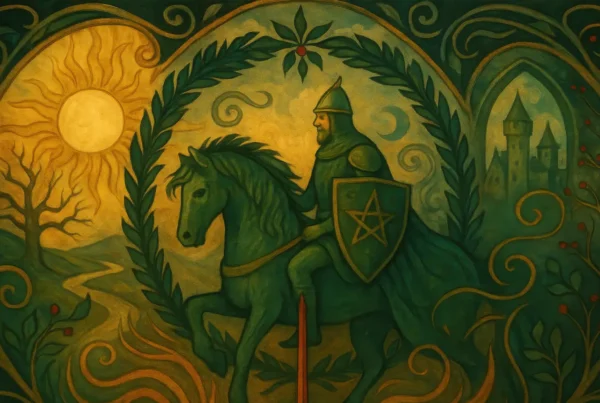
In mythic language, this hunger appears as the fall of the King. The King represents order, radiance, vision, and legitimacy, the life-giving masculine that blesses life into motion. When this figure loses coherence within culture, the personal father often carries that loss. Authority dims into shame or rigidity. Guidance collapses into silence or volatility. Strength loses its orientation toward service and steadiness. Children grow within a field where the masculine lacks a stable center.
The Father Wound expresses itself through many inner patterns. Some turn upward toward achievement, spirituality, or perfection as a way of restoring lost radiance. Some draw inward, carrying uncertainty about purpose or worth. Some seek masculine presence through partners, mentors, or institutions, loading them with unspoken longing. Others hold suspicion toward guidance itself, unsure how to receive direction or blessing. Many live with a quiet ache, sensing an absence without a clear name.
Within every father live two streams. One carries his wish to guide, protect, and transmit strength. The other carries his inherited fears, shame, and unintegrated childhood experience. Healing unfolds through holding both streams with clarity. The father becomes visible as a whole human being shaped by forces larger than himself, carrying both radiance and shadow within the lineage.
This recognition opens the way toward reclaiming the inner father. The psyche begins to restore its own source of direction, strength, and authority. Inner fathering offers structure without rigidity, agency without domination, accountability without shame. The Inner Child receives guidance, protection, and blessing through the adult self, and the masculine frequency settles into the nervous system with steadiness and trust.
As this integration deepens, a sense of inner kingship returns. Life regains orientation. Voice strengthens. Purpose clarifies. The Father Wound transforms into a source of grounded agency, and the path opens toward the work that gathers all strands together: the movement toward forgiveness as an inner reorganization of identity and power.
The Path of Forgiveness
Forgiveness unfolds as a movement of identity rather than a moral gesture. Within inner work, it arises through a reorganization of relationship to the past, where the center of gravity shifts from inherited injury toward present authorship. The psyche begins to recognize that what shaped early pain lived within a wider field of unintegrated experience carried by others long before the child entered the story.
This recognition brings clarity. Parental harm reveals its roots in unparented places, inherited fear, and emotional limitation. Understanding grows around how patterns continued through the family system until they encountered awareness capable of receiving them. The wound becomes intelligible as transmission rather than personal definition, and the self loosens its attachment to an identity formed around injury.
Forgiveness develops through distinct inner movements. Awareness first settles on the lived impact of early experience, allowing emotional truth to surface with care and dignity. Understanding then widens to include the parent’s inner world, their childhood adaptations, and the forces that shaped their capacity to give. The psyche releases roles it once carried to maintain connection or safety, and inner authority begins to return. Re-parenting follows as the adult self offers the protection, guidance, and attunement once sought outwardly. Integration completes the arc as emotional charge softens and the story finds its place without directing the whole of identity.
Through this process, energy reorganizes. The internalized parental voice loses its grip. The body settles. Attention moves freely in the present. Forgiveness arrives as a felt shift, recognizable through steadiness, spaciousness, and an ease in turning toward one’s history. The lineage remains honored, and its unfinished weight releases its hold on the future.
This moment clears the inner field. The past holds coherence without commanding attention. The heart stands open without bracing. From here, the path naturally turns toward reunion. The adult self meets the Inner Child with presence and care, and the work of integration continues as child, adult, and lineage come into relationship within a single, steady inner home.
The Returning Child — Exercise
A guided practice for meeting the child who lived through your parental wounds
This practice is not about confronting your parents.
It is about meeting the younger you—the one who absorbed patterns, carried burdens, interpreted silence, and learned to live without what they needed.
This is where the true repair begins.
Set aside 15–25 minutes.
Find a quiet space, a soft light, a blanket if you wish.
Let this be a moment of meeting, not striving.
1. Grounding the Present Self
Sit comfortably.
Let your breath slow.
Imagine the weight of your body settling into the earth beneath you—as if roots are growing from your spine, anchoring you into something older and steadier than your story.
Feel your adult self arrive.
The one with perspective.
The one with choice.
The one who survived.
This is the self who will meet the child.
2. Calling the Child Who Carries the Mother or Father Wound
In your mind’s eye, allow a doorway to appear—
the doorway of the first home you remember,
or the home where the wound first took shape.
Standing just inside, you see a small figure.
Your younger self.
Do not call them forward.
Let them come in their own time.
Notice:
- How old they appear
- What their posture is
- What emotion is on their face
- Whether they are wary, eager, shy, angry, or numb
- What they seem to need before they can approach you
There is no right image.
Children arrive exactly as they are.
3. Meeting Them With Full Presence
When they are ready, kneel or sit so you are at their level.
Do not fix, reassure, or explain anything yet.
Simply be with them.
You might say, softly:
“I see you.”
“I remember what you carried.”
“You did not imagine any of it.”
“I’m here now.”
Let them respond in whatever way they choose—
through emotion, silence, imagery, or simply a felt sense.
They may show you moments linked to the Mother Wound:
times when they felt unseen, overburdened, over-attuned, or emotionally parented by the mother.
Or they may reveal moments linked to the Father Wound:
times they felt unprotected, unheard, untaught, or unblessed.
Let their reality be true.
4. Listening for the Essential Need
Ask gently:
“What do you need from me now?”
Let the answer come without forcing it.
It may be:
- “Hold me.”
- “See me.”
- “Protect me.”
- “Tell me I didn’t do anything wrong.”
- “Stay with me.”
- “Choose me.”
- “Speak the truth.”
- “Don’t leave.”
Or they may simply cry.
Crying is the answer.
Stay until they finish expressing whatever they bring.
5. Offering the First Re-parenting Gesture
From your adult self—
the self who has more capacity than any parent you ever had—
offer what the child asked for.
Hold them.
Shield them.
Speak the words they needed then.
Let your body soften around them.
Offer warmth, protection, patience.
This moment is the first repairing of the lineage.
This is you becoming the mother or father your younger self needed.
6. Integrating the Child Into Your Present Self
You might imagine lifting them gently and carrying them out of the old doorway,
or placing a hand over your heart and allowing them to rest there,
or letting them merge back into your adult body with a feeling of relief.
Tell them:
“You are not alone anymore.”
“I won’t abandon you.”
“We go together from here.”
Feel the shift—
however small—
as the past loosens its grip and the present begins to take shape.
7. Closing the Practice
Open your eyes slowly.
Place a hand over your chest or your belly.
Breathe once for your Inner Child,
once for the adult you are now,
and once for the lineage that is beginning to heal through you.
If you wish, write down what you saw or felt.
This becomes a map for future sessions.
An Invitation Into Inner Child Work
If this exercise stirred something within you—
a memory, an ache, a sense of recognition—
know that this is the beginning of a profound journey.
Your Inner Child is ready to be met.
Ready to be re-mothered where nourishment was missing.
Ready to be re-fathered where guidance and blessing were absent.
Ready to be integrated as part of your wholeness.
This is the work we do through Inner Child practices:
a gradual re-weaving of safety, belonging, and identity from the inside out.
You are not returning to the past.
You are retrieving the part of you that never stopped waiting.
Closing Invitation
Healing our parental wounds is not an act of returning to the past—it is an act of returning to ourselves.
We do not repair the lineage by revisiting conflict or recreating old dynamics.
We repair it by tending to the child within us who survived the family’s unfinished stories.
You have walked through the terrain of the Mother Wound, the Father Wound, the lineage you inherited, and the mythic architecture that shapes how we love, trust, and inhabit our own lives.
And now you stand at the threshold where inner work truly begins.
If something in this article stirred recognition—
a tightening in the chest,
a memory resurfacing,
a longing for safety,
or a quiet “yes, that’s me”—
honour it.
These are not coincidences.
They are invitations from the younger parts of you who have been waiting for this moment.
You do not need perfect clarity to begin.
You do not need your parents’ participation.
You do not need to feel “ready” in any complete sense.
You only need the willingness to turn inward with compassion and curiosity.
Inner Child work is not a single practice—it is a relationship.
It is the slow rebuilding of trust with the parts of you that endured more than they could express.
It is a return to the roots of your own being, where the original stories of worth, love, and safety were formed.
Through this work, you will find:
- a softer relationship with your past
- a clearer understanding of your patterns
- a wiser connection to your emotional needs
- and a restored sense of inner authority
Most importantly, you will discover that the strength you’ve been seeking was never outside you—it has been waiting inside you, patient and intact, beneath the layers of adaptation.
Your healing does not rewrite history.
It rewrites your future.
If the Mother Wound touched something tender in you,
if the Father Wound awakened something long-buried,
if the Returning Child called your name—
then this is your moment.
You are invited to continue the journey through Inner Child work,
to meet your younger self with depth,
to re-parent what was unmet,
and to reclaim the soul you were always meant to live from.
The doorway is open.
Whenever you are ready—
step through.
Click here for more Inner Child Exercises.
If this article resonates and you’d like to find out more, please read more about The Inner Council Inner Child Workshop. If you would appreciate a down to earth and totally confidential chat with us, then please feel free to contact us.